


Product Overview
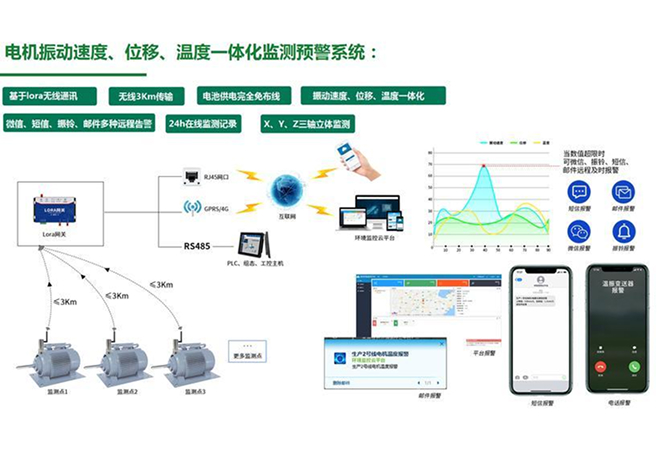
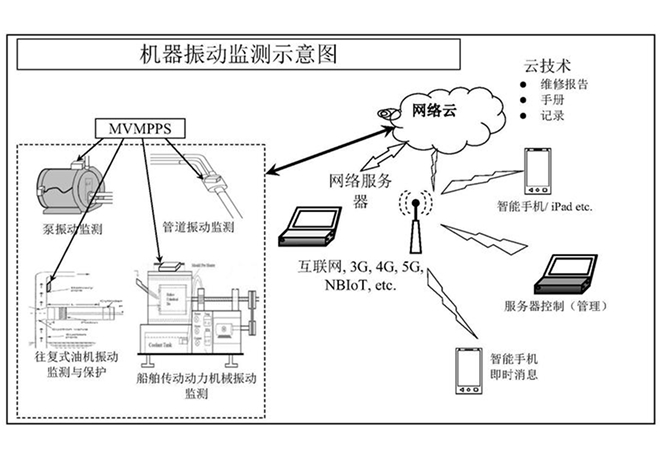
Uses a B/S architecture to enable multi-terminal access through browsers, supporting remote monitoring by on-site personnel and managers and reducing client maintenance costs.
The system is divided into three layers: front-end display layer (Web interface), business logic layer (data analysis and alarms), and data storage layer (relational database).
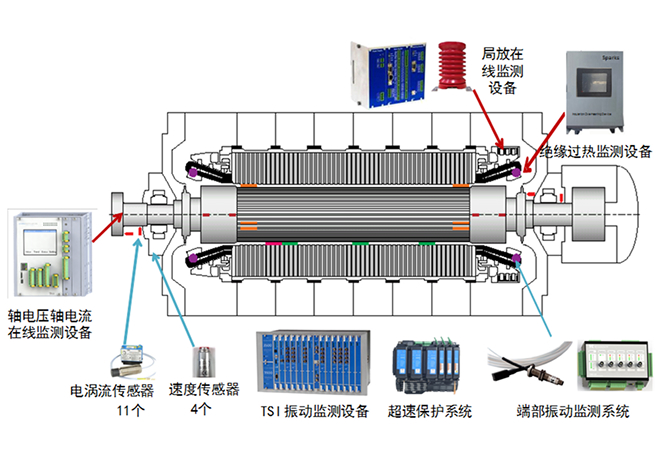
It monitors vibration waveforms, spectra, and process-quantity data in real time, supporting parallel monitoring of multiple devices.
An integrated alarm module sets multi-level thresholds (warning/danger) and triggers shutdown protection.
The system is divided into three layers: front-end display layer (Web interface), business logic layer (data analysis and alarms), and data storage layer (relational database).
It monitors vibration waveforms, spectra, and process-quantity data in real time, supporting parallel monitoring of multiple devices.
An integrated alarm module sets multi-level thresholds (warning/danger) and triggers shutdown protection.

Technical Highlights
1. Data Transmission and Integration
Supports hybrid networking of RS485 bus and industrial Ethernet, compatible with Modbus protocol, enabling efficient sensor-data acquisition.
Uses an edge-computing gateway to preprocess vibration data, reducing network latency and server load.
2. Intelligent Analysis Algorithms
Combines FFT spectral analysis, wavelet transform, and other time-frequency-domain algorithms to accurately identify bearing wear, rotor imbalance, and other faults.
Integrates AI models such as LSTM and CNN to enable automatic fault classification and remaining-life prediction.
3. Visualization and Scalability
Provides dynamic waveform charts, spectrum waterfall charts, and other visualization tools, supporting historical data review and comparative analysis.
Modular design allows later expansion of sensor nodes or functional modules, such as air-gap monitoring.
The system should comply with industrial safety standards such as IEC 61508, and high-precision sensors such as 24-bit ADC and anti-interference design are preferred.