


Main Functions:
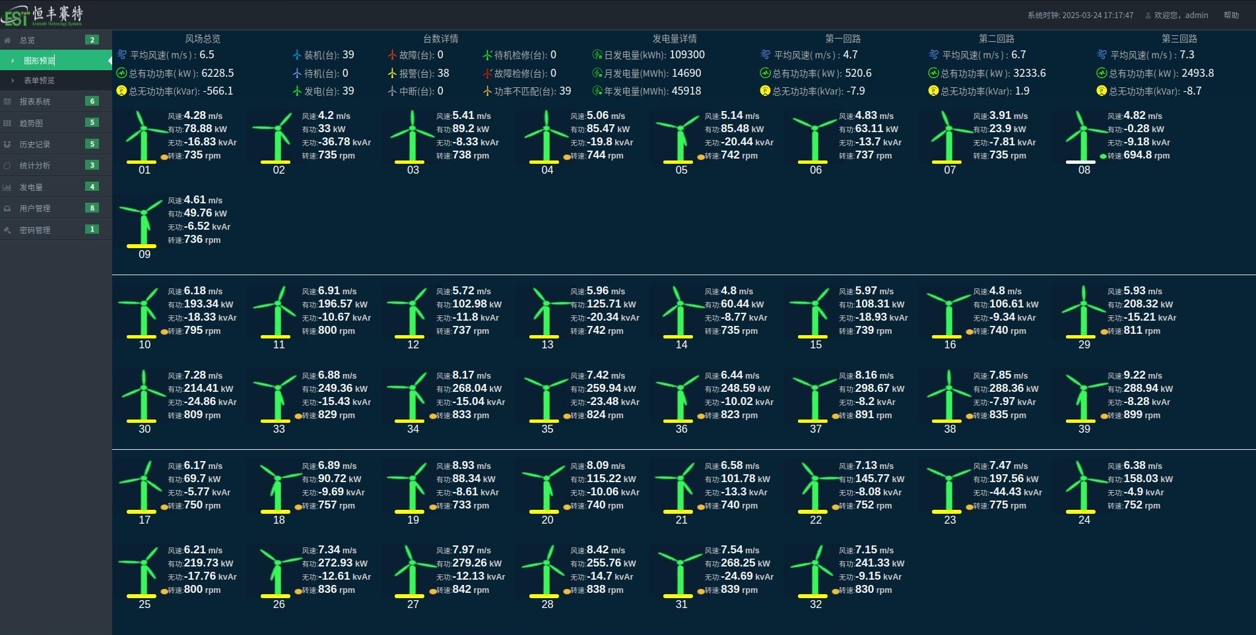
Panoramic Monitoring and Visualization
1. Multi-mode views: matrix view (number display), ring-line view (topology statistics), list view (parameter comparison), and map view (geographic distribution), intuitively presenting the status of all turbines in the wind farm;
2. Real-time parameters: wind speed, power, power generation, fault codes, and other data updated at second-level intervals, supporting single-turbine and full-farm mode switching.
Intelligent Control and Dispatching
1. Remote commands: start/stop, active/reactive power adjustment, and power-factor setting, with dual-password verification and batch operation support;
Fault Warning and Diagnosis
1. Multi-level alarms: alarms, faults, and messages are classified into three levels, recording turbine name, time, code, and handling personnel;
2. Predictive maintenance: analyzes equipment life based on historical data, triggers maintenance work orders in advance, and reduces downtime losses.
Data Management and Analysis
1. Storage architecture: second-level data retained for 3 months and minute-level data archived long term, supporting more than 20 report types such as wind-frequency charts and power curves;
2. Open interfaces: provides OPC, Modbus TCP, and other protocols for seamless integration with third-party systems such as power forecasting and vibration monitoring.
1. Multi-mode views: matrix view (number display), ring-line view (topology statistics), list view (parameter comparison), and map view (geographic distribution), intuitively presenting the status of all turbines in the wind farm;
2. Real-time parameters: wind speed, power, power generation, fault codes, and other data updated at second-level intervals, supporting single-turbine and full-farm mode switching.
Intelligent Control and Dispatching
1. Remote commands: start/stop, active/reactive power adjustment, and power-factor setting, with dual-password verification and batch operation support;
Fault Warning and Diagnosis
1. Multi-level alarms: alarms, faults, and messages are classified into three levels, recording turbine name, time, code, and handling personnel;
2. Predictive maintenance: analyzes equipment life based on historical data, triggers maintenance work orders in advance, and reduces downtime losses.
Data Management and Analysis
1. Storage architecture: second-level data retained for 3 months and minute-level data archived long term, supporting more than 20 report types such as wind-frequency charts and power curves;
2. Open interfaces: provides OPC, Modbus TCP, and other protocols for seamless integration with third-party systems such as power forecasting and vibration monitoring.
Product Features
01
Real-time performance: data refresh frequency ≤1 second, supporting second-level data storage and high-precision analysis.
02
Compatibility: compatible with Windows, Linux, and domestic operating systems, supporting cross-platform deployment and multi-browser access.
03
Scalability: modular design, capable of monitoring 300+ wind turbines and supporting mixed turbine models and distributed deployment.